
 Increase
customer satisfaction by offering personalized call treatment.
Increase
customer satisfaction by offering personalized call treatment.Moving from Call Center to Contact Center: A Strategic Guide for Modern Customer Support
Published On March 8, 2021 | Last Updated December 12, 2025
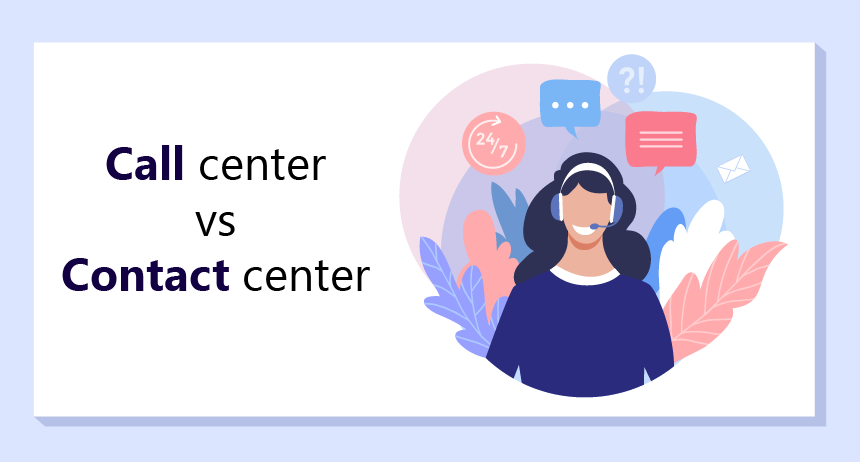


In today’s customer service landscape, relying solely on voice support is no longer enough. While call centers have long been the backbone of customer support, nowadays, customers expect fast, seamless, and consistent support across multiple touchpoints.
The shift to a contact center is more than modernizing your operations; it’s a strategic move to meet evolving customer expectations and drive long-term business growth. For businesses still running voice-only call centers, transitioning to an omnichannel contact center may seem daunting. In reality, with the right approach and tools, the transition can be smooth and impactful for your operations and customer experience.
What is a Call Center vs a Contact Center
Call centers typically handle inbound and outbound voice calls, while contact centers, either multichannel or omnichannel, handle interactions from other communication channels, such as IM, chat, SMS, and more.
At ComputerTalk, our ice Contact Center is an omnichannel solution, meaning we handle voice, IM, chat, SMS, email, and more. Our customers have the ability to seamlessly switch between channels, all within a unified interface.
Why Organizations are Moving Beyond Voice-Only Support
While voice support remains a critical channel for any contact center, especially when it comes to complex or sensitive inquiries, there are some limitations with relying on voice alone.
Common challenges of voice-only operations include:
- No alternative channels when call volumes spike: If queues are long, customers can wait on hold or abandon the call. Without other channels, like chat, email, or self-service options, there’s no path to get quick answers.
- Struggle to scale efficiently to meet demand: Adding capacity requires hiring and training more agents, and investing in infrastructure, which can be a slow and expensive process.
A modern contact center enables organizations to manage support across multiple channels without overwhelming agents or creating siloed processes. While the key benefit of contact centers is the ability to provide various channels of communication, an omnichannel contact center takes it a step further by creating a unified and efficient ecosystem.
The Business Case for Transition
The decision to move from a call center to a contact center is strategic. Companies that embrace this modernization often see tangible benefits, including:
- Improved customer experience
- Enhanced agent productivity
- Faster issue resolution
- Data-driven decision making
- Scalability and flexibility
The Outcomes of Transitioning to a Contact Center
Transitioning from a voice-only call center to a modern contact center brings tangible benefits for both your organization and customers. Beyond simply adding channels, the real value comes from improved customer experiences, smarter workflows, and actionable insights.
1. Unified Customer Experience
In a traditional call center, customer interactions happen primarily over the phone. This means agents typically only see the details from the current call or past phone interactions, so there’s no full view of the customer’s complete journey.
A contact center unifies interactions across all channels – voice, email, chat etc. – into a single system. This allows agents to understand the customer’s history and context across every touchpoint, enabling faster, more consistent, and more personalized support.
2. Enhanced Agent Productivity
Voice-only support forces agents to handle one interaction at a time. This limitation can lead to longer wait times and higher call abandonment rates.
With omnichannel contact centers, agents can stay productive even when voice queues are slow. If there are no incoming calls or IMs, they can work through emails, support tickets, or other asynchronous channels. When multiple chats are active, they can easily switch between conversations – responding to one customer while waiting for another to reply. This flexibility enables agents to stay productive and improves overall service efficiency.
3. Faster Issue Resolution
In traditional call centers, even those with intelligent routing, agents are still limited by the information available from the call alone. Without additional context from other channels, it can be harder to match customers with the most suitable agent right away.
With intelligent routing and workflow automation, customers are connected to the right agent on the first call. This leads to decreased customer frustration due to the fact that they are less likely to be transferred and have to repeat themself to each agent they are transferred to.
4. Proactive Customer Engagement
Voice-only call centers are primarily reactive, only responding when customers initiate contact. While outbound calls are possible, they require significant agent time and are difficult to scale efficiently.
Omnichannel contact centers have the option to enable proactive engagement across multiple channels, allowing agents or automated systems to reach customers with updates, reminders, or follow-ups. Integrated customer data ensures these interactions are personalized and relevant, while automation triggers messages based on ticket updates, order delays, etc. This approach reduces repeat contacts, minimizes escalations, and delivers faster, more convenient customer experiences.
Principles for a Successful Migration
A smooth transition isn’t just about implementing new technology; it’s about strategy, people, and processes. Organizations that follow these principles see stronger results:
1. Start with the customer journey
Map typical customer interactions and identify pain points, redundancies, and opportunities for improvement. This ensures the transition addresses real challenges rather than just introducing new tools.
2. Align teams and workflows
Omnichannel success requires collaboration between agents, supervisors, and other support team members. Unified workflows and clear processes prevent siloes and maximize efficiency.
3. Adopt a phased approach
Trying to implement every capability at once can be overwhelming for your operations. Start small and implement the high-impact processes first, refine them, and then expand incrementally.
4. Leverage insights continuously
Modern contact centers provide data that goes beyond simple interaction volumes. Use reporting and analytics to monitor performance and optimize operations.
5. Design for flexibility
Customer expectations are evolving. Build processes and systems that are adaptable, scalable, and capable of supporting new initiatives without disrupting existing operations.
How ComputerTalk Can Support Your Transition
Transitioning from a call center to a contact center is easier with a modern CCaaS solution like ice Contact Center. With an omnichannel solution like ice, the platform provides a unified interface where agents can manage all customer interactions, voice, email chat, etc., without switching between multiple tools.
With intelligent routing, AI-powered tools like chatbots, and more, your team can resolve issues faster, deliver more personalized experiences, and make data-driven decisions. Scalable and flexible, ice Contact Center lets you expand channels and add capabilities at your own pace, helping organizations modernize strategically while keeping operations smooth.
Why Contact Centers Are the Future of Customer Support
Compared to voice-only call centers, omnichannel contact centers offer a more efficient, flexible, and modern support experience. Because all channels are handled in one platform, agents spend less time learning multiple systems and more time helping customers. As communication trends evolve and digital channels grow, contact centers help organizations stay competitive and aligned with customer expectations. Finally, advanced AI capabilities, such as chatbots, sentiment analysis, and contact summarization, enable smarter automation, faster resolutions, and improved customer experiences.
Transitioning from a call center to a contact center is about creating better customer experiences, smarter workflows, and more efficient operations. Organizations that focus on strategy, phased adoption, and unified operations see real results: happier customers, empowered agents, and faster results.
Modern customer expectations demand more than voice support. The time to evolve is now. With the right approach and the right platform, your organization can turn this transition into a strategic advantage.
More from our blog
 Today, customer experience should be a priority for every business – no matter which industry you might serve. But every sector faces its own challenges when it comes to earning and maintaining customer loyalty. Manufacturing companies, for instance, have to...
 It’s no secret that many areas of everyday life and business are becoming increasingly digitized.
 I am the 7th child out of an 8 child family. I learned early on that I was part of not just a family but a team. There was a big age difference, but that did not stop us from...